



A Treatise on Custom-Made or Bespoke Clothing
by Alexander S. Kabbaz, Master Shirtmaker
Copyright © 2003-2016 Alexander S. Kabbaz, All Rights Reserved
|
Author's Note:After 40+ years as a custom clothier and haberdasher, I've grown increasingly annoyed at the merit-less bandying about of the age-old terms "custom-made" and "bespoke". These terms, synonymous really, have specific meanings. As so many of you have sought definition from Joelle or I over the years, I've penned this Caveat Emptor series.
It begins with A Treatise on Custom-Made Clothing, written from my point-of-view as a traditionalist shirt maker and supposed expert in the field. It's long. It's detailed. But so is well-made clothing. Save it in your file for the next time you interview a fine clothier or dressmaker. I would love to hear your thoughts and answer your questions. Take me to task: Write back to me with your thoughts, positive or not. I'll answer them (anonymously, of course) in our upcoming issues. |
|
Take a piece of fabric six feet long and three feet wide. Cut a one foot circle from the center. Place this hole over your head. Take a stapler and staple the sides together below your arms. Voila! You've made a shirt! Now that you are a qualified shirt maker, realize that anything beyond those simple basics involves more than just a knowledge of pattern making, cutting, and sewing. It requires a philosophy, some modicum of pride in one's work, a widely varying degree of knowledge of the art and the craft, and the intangible ability to translate clients' verbal descriptions into visually pleasing realities.
As you learned in the first paragraph, making a shirt can be extremely simple. Making a shirt that fits, not only as well as it can but especially the way the client wants it to, can be extremely difficult.
The Two Philosophies of Bespoke ClothingA bespoke maker can adhere to one of two goals with every new client: Most have a simple goal which I term the First Philosophy:
a] Establish a minimum order which guarantees that you will make a profit.
b] Make a "custom" pattern which does not deviate too far from the norms: stay within 'acceptable' parameters of fit, styling, quality and price.
c] That way, if the client doesn't like the results of your work, you can claim you 'followed the traditional bespoke methods' and, especially, you haven't lost any money.
The First Philosophy is wonderful. It opens you to no accusations, leaves no possibility of grave error, and guarantees your bottom line. Seems ideal, and that is why it is the Majority Philosophy.
Others adhere to a riskier concept, the Second Philosophy:
a] Establish a hefty minimum order to determine whether the client is serious or not. Once that is out of the way, forget about money and begin the fitting process ... and continue it until you, the maker, are satisfied with the fit.
b] Have a serious initial interview with the potential client:
Are they interested in getting their shirts quickly? Bad.
Do they "not really have time for fittings"? Worse.
Is 'the better-half in charge' of the fit and styling? Awful!!!
Specifically:
So what do you do with the first, second, third, etc. fitting samples? Every January 1, you buy a very large, empty box. Every December 1, you telephone the Salvation Army for a pickup.
In this treatise, I propose various conceptual themes and procedures. At times I'll interject as examples my own parameters which apply to those themes and procedures. Here is the first of such.
As regards Philosophy, the First or the Second: I am partial to the ...
Second Philosophy.
That finishes Philosophy.
So where does the Pride enter into it? Same as it does in any other arena. Here are a few telltale signs:
Manifestation of the Second Philosophy: Attire speaks before you utter a single word. Your appearance is the window through which your are first viewed. The most important result of our initial consultation lies not in the extensive series of measures we place in your file, but in what we garner about your personality, your profession, your taste, and your station in life. Important is not that particular fabric which offers us the greatest profit. Important is the suitability of your wardrobe. This can be considered only if we gain a comprehensive understanding of who you are.
Important lies not only in our complimenting your wiser selections and in offering you others from which to choose, but also in having the temerity to suggest that something you might want would be entirely inappropriate for you.
In short, the image you should portray is the responsibility we wish to accept.
The Process, simplified, as I see it ... and written as if you were my client ...  On your first visit, we'll chat for a while in order that I might gain a proper sense of your needs and who you are. Then we'll discuss styling and fit while I take some 35 measures and notes. Later, I'll design, strike, and cut your individual basic pattern. This will incorporate the styling details we discussed and is the springboard from which we'll develop your wardrobe during ensuing years. I'll use this pattern to cut, stitch, and launder your first sample which tests my ideas and measures. We use 2x2 120's or 2x2 170's, based on our discussion of your preferences. (Others begin with muslin which is acceptable for the first try-on).
One week later, faster if circumstances dictate, you return to try on this laundered sample. You criticize, we criticize and pin-fit. We alter your pattern, cut and launder a new shirt, and you return for a second fitting.
Then we again revise your pattern and, a short while later, send you a third sample. This you wear for a day or two thusly insuring that you are completely aware of your likes and dislikes.
These steps are repeated as often as necessary. Once your pattern has been finalized in this manner - to my satisfaction - we cut your first order which is both a minimum and maximum of six shirts. The styles need not all be the same; every fabric may be different. After this initial order, you may order in any quantity desired from one and up. This entire process can be collapsed into two intensive days. This is accomplished by your staying locally near our East Hampton studios for two days and one or two nights. Each day begins and ends with a fitting with beach or shopping in-between. At the end of the two day stint, your pattern is finalized ... and your tan is improved!
In Summation:
Again as if you were my client ... What will a good custom shirt maker do ... and how?
As far as shirts, blouses, or furnishings, virtually anything. We will design originals (our preference), copy styling details of your old favorites, or work from photos or sketches of styling preferences you might like. We can, if necessary, work initially from your measurements and conference video of you. Delivery varies seasonally and depends (the first time only) on your availability for fittings. Quality should not be rushed. Monograms, if desired, are additional. They are done by hand and require extra time. All of our work is done here on the premises.
Each shirt is slightly different. In a process where everything is hand-done and every shirt considered as a unique entity, this is as it must be. Our promise, therefore, is quite simple. If it is not perfect, we shall make it so ... without question.
Our charges are set from a viewpoint which allows us to concentrate our efforts solely on the caliber of our work. Truthfully, pricing is the easy part. Difficult is when we sit down and carefully consider each one of the thousands of individual stitches we make in some 12 miles of Egyptian-grown, European-woven long staple cotton yarn, to which we hand-sew 14-20 New Zealand- grown Mother-of-Pearl buttons. Add eight to 12 hours of tailoring, a hefty dose of creativity, a lifetime of pride and you get...one shirt!Shirt Fact:
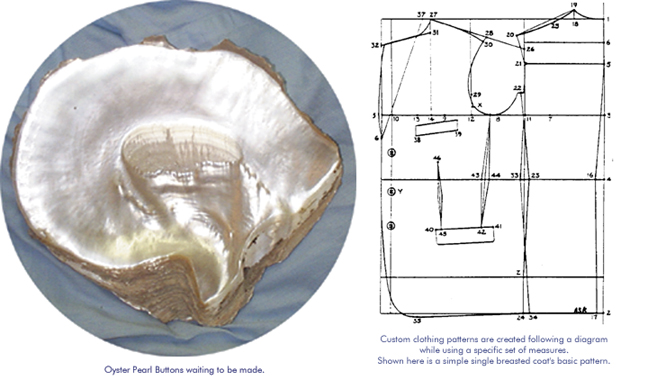 This is an oyster shell, about 50 years of age when harvested in New Zealand. From this comes Mother-of-Pearl buttons. Its actual size is about 10" across. Feel a button. If it feels "cold" it's likely Pearl. If "warm", probably plastic. On the right is a single breasted suit pattern. Ask your maker to show you one of his. If there aren't any ... where is the work really done?
I could go on for pages about the complete individual pattern, an entirely hand-cut garment, the magnifying loupe through which we inspect the fabric we shrink as necessary before cutting, and the many hundreds of other techniques we use to insure the perfection of our craft. However, we consider this not only proprietary but also firmly believe that this is our responsibility. Suffice it to say, thanks to our many loyal clients, we are happy to have the ability to direct our skill and attention solely toward the quality of our shirts. Before you place a subsequent order, I must see you in a few of the shirts you've found most pleasing. Fine woven cotton will, over time, shape and adapt itself to the wearer. It is only after that has been accomplished that I can make the final little nips and tucks to your permanent pattern. This, by the way, remains an ongoing process. Additionally, should more than four or five years pass between your actual visits to our shop, I'll most probably refuse to make any more shirts until I see you in a recent creation. After all, our only advertising is the answer you give to the question, "Where did you get that shirt?"
Fitting new clients is our responsibility - solely our responsibility. Should your measurements change or should you desire any alteration in fit at a later date, it is solely your responsibility to so inform us! Otherwise, lack of this knowledge will obviously cause us to cut your order without alteration of your permanent pattern ... and cause you to pay for ill-fitting work! Should we for any reason make changes to your pattern, we shall normally cut one shirt from your order and send it for your approval. Once you approve the change, we'll then proceed with the remainder. Should you decide later on that you want further changes to the just-made shirts, such alterations will be charged at our prevailing rates.
That is The Process as I see it.
Thank you for reading.
No, we do not sell our Custom Shirts online.
If you are interested in having custom shirts made,
please contact Alexander Kabbaz for information and process details.
|
|
|
||